Valid Tax Invoice Requirements in South Africa (SARS Checklist)
What SARS requires on a valid tax invoice. Full and abridged invoice rules, the R5,000 threshold, and why an invalid invoice costs you input VAT.
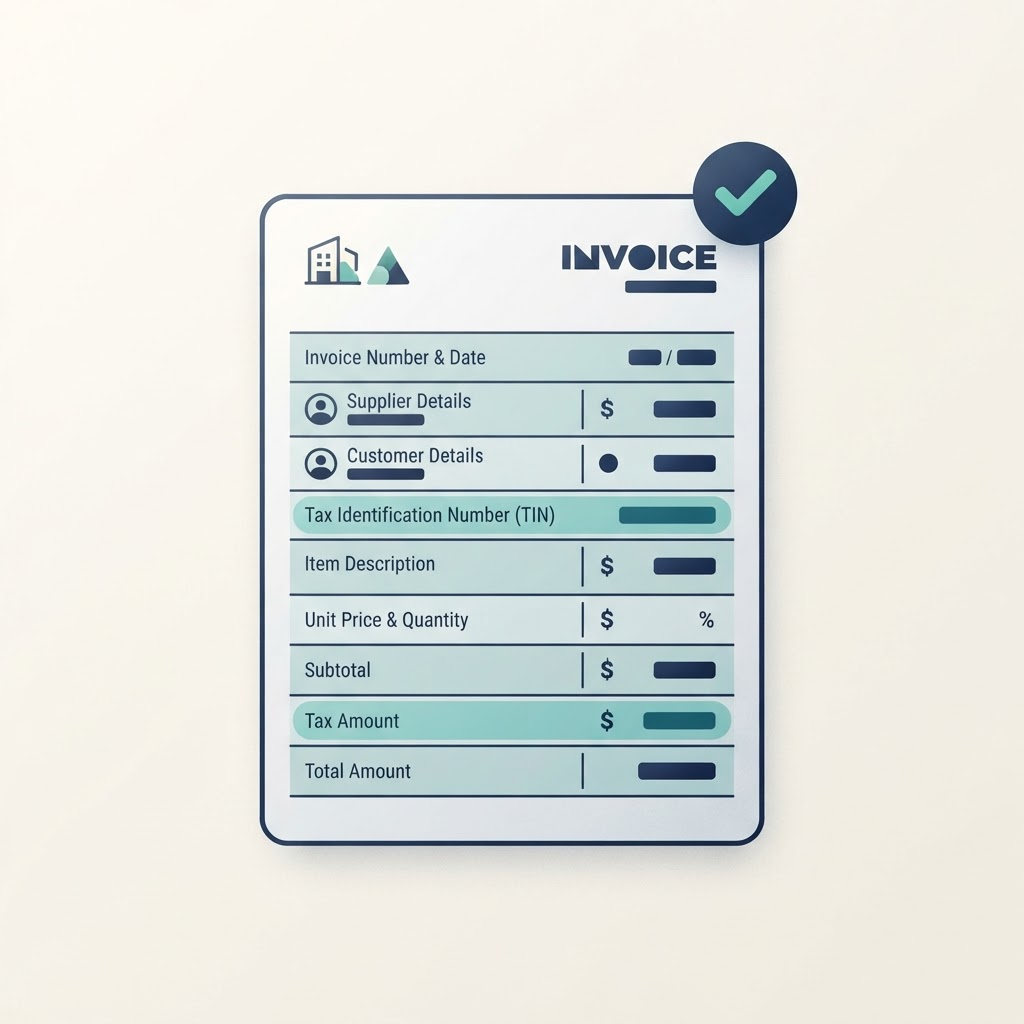
This is the checklist, and the traps.
Who may issue a tax invoice
Only a VAT-registered vendor. If you are not registered, you issue an ordinary invoice with no VAT line and no VAT number on it. Charging VAT without being registered is a serious offence.
Registration becomes compulsory once your taxable turnover exceeds R1 million in any twelve-month period. You may register voluntarily above R50,000.
Full tax invoice: the required fields
For any supply above R5,000, all of the following must appear:
Abridged tax invoice: the R5,000 rule
For supplies of R5,000 or less, you may omit the recipient's name, address and VAT number. Everything else still applies.
For supplies under R50, no tax invoice is required at all, though you should still keep a record.
The practical takeaway: if your invoice is above R5,000 and you have not captured the customer's details, it is not valid.
The mistakes that cost people money
Missing VAT number. Yours or, where required, theirs. The single most common defect.
Vague descriptions. "Services rendered" tells SARS nothing about whether the supply was taxable, exempt, or even real.
Duplicate or skipped serial numbers. Two invoices with the same number undermines the entire sequence. Gaps invite questions about what you deleted.
Wrong VAT arithmetic. VAT is 15%. To extract VAT from a VAT-inclusive amount, multiply by 15/115, not by 15%. On R1,150 inclusive, the VAT is R150, not R172.50.
Charging VAT before your registration is effective. You may only charge from your effective registration date, not from when you applied.
Claiming input VAT on a supplier's invalid invoice. Their error becomes your disallowed claim. Check supplier invoices before you file.
Keeping records
SARS requires you to retain records for five years from the date of the last entry. That covers invoices issued, invoices received, credit notes, and the underlying documentation.
Electronic records are acceptable provided they are readable and retrievable for the full period. A folder of photographs of paper slips with no index is technically retained and practically useless in an audit.
Credit notes
If you cancel or reduce a supply, issue a credit note that references the original invoice number. Do not delete the original invoice and do not edit it. The audit trail is the point.
A worked example
Supply: two days of consulting at R8,000 per day, VAT exclusive.
Because the supply exceeds R5,000, this needs a full tax invoice with the recipient's name, address, and their VAT number if registered.
Had the supply been R4,000, an abridged invoice omitting recipient details would be acceptable.
Getting this right automatically
Every field above is mechanical, which means software should handle it. LEDGA generates SARS-compliant tax invoices with sequential numbering, correct 15% VAT calculation, and the full versus abridged distinction applied by value, so a R6,000 invoice cannot go out missing the customer's details.
Before your next VAT201, spot-check five supplier invoices against the list above. If any fail, you are about to claim input VAT that SARS can disallow.
Start invoicing free with LEDGA.
Frequently Asked Questions
What must appear on a valid tax invoice in South Africa?
The words "Tax Invoice", your business name, address and VAT registration number, the customer name and address, a unique serial number, the date, a description of what was supplied, the quantity or volume, and the value, the VAT charged and the total. Missing any of these can invalidate the invoice.
What is an abridged tax invoice?
For supplies of R5,000 or less you may issue an abridged tax invoice, which does not require the recipient name and address. Above R5,000 you must issue a full tax invoice with all recipient details.
Can I claim input VAT without a valid tax invoice?
No. SARS can disallow the input VAT claim if you cannot produce a valid tax invoice, which means you carry the 15% yourself. This is one of the most common findings in a VAT audit.
Can I issue a tax invoice if I am not VAT registered?
No. Only VAT-registered vendors may issue tax invoices or charge VAT. If you are not registered, issue a normal invoice with no VAT line and no VAT number.
Ready to simplify your accounting?
LEDGA handles VAT, invoicing, and SARS compliance automatically.
Start Free TodayRelated Articles
Small Business Tax Deductions in South Africa: What You Can Claim
Which business expenses SARS allows as deductions, which it disallows, the record-keeping standard, and how to claim without triggering an audit.

UIF Registration and Contributions: What Employers Must Do
UIF explained for South African employers. The 1% plus 1% contribution, the R17,712 earnings ceiling, registration steps, and monthly declarations.
PAYE Registration in South Africa: A Step-by-Step Guide
How to register for PAYE with SARS, the 21-day deadline, EMP201 and EMP501 obligations, and how PAYE, UIF and SDL fit together.